
What Are DC-Blocking Capacitors, and Why Are They Important?
Electronic devices power our world and allow us to communicate. In all applications requiring signal integrity and accurate power amplification, blocking capacitors are used to provide clean waveforms and correctly amplified voltages.
What Systems Rely on Stable Waveforms?
Generally, waveform systems can be broadly defined into power-related alternating current (AC) and communications-related radio frequency (RF) applications. Both employ waveforms to provide power or information. All of these devices require a blocking capacitor to ensure the waveform conforms to the desired specifications. Some standard electronic devices requiring blocking capacitors are:
- Audio amplifiers
- RF systems such as radio, broadcast television, and microwave communications devices
- Power converters and amplifiers, AC-DC, DC-AC, and DC-DC
- Communications connectors
- Sensor interfaces
- RF filters
Why are DC-Blocking Capacitors Necessary?
In AC and RF waveforms, the desire is to have the waveform highs and lows navigate around a known base voltage. Typically, this is designed to be a waveform centered around zero volts. Some designs, like audio amplifiers, require the waveform to circulate a known direct current (DC) voltage.
However, this desire to achieve a known center level can be thwarted by the unwanted injection of a DC voltage onto the line. Some sources of DC pollution may include the following:
- Power supply residual voltage
- Offset voltage generated by a device
- Biasing circuits to control voltage levels between two (or more) levels
- Electrochemical effects such as galvanic corrosion
- Faulty or imbalanced components within a system
How Blocking Capacitors Remove Unwanted DC Line Levels
.webp?sfvrsn=cb1241b1_1)
Figure 1. Capacitor physical diagram. Source.
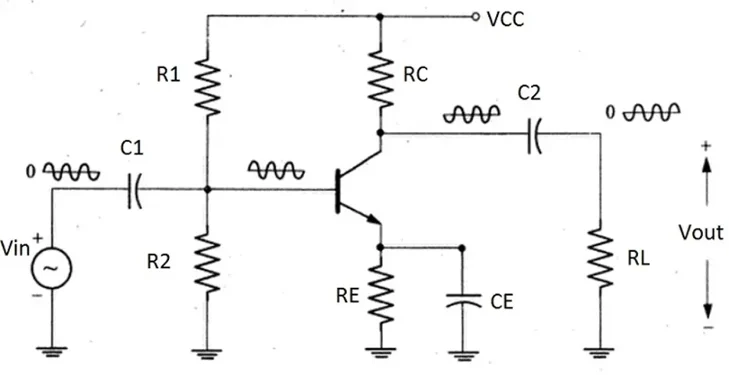
In the case of blocking capacitors, this device is placed in series with the load. Blocking an unwanted DC voltage occurs because the capacitor acts as an open to the DC voltage, not allowing it to pass through the dielectric. In Figure 2 below, capacitor C2 acts as a blocking capacitor in this voltage divider design with the output waveform around zero volts.
Any waveform on the line produces electromagnetic waves that transit the dielectric in inverse polarity to the originating wave. Thus, the DC voltage is blocked, and the wave, with a properly valued capacitor, circulates about zero volts, as desired.
In the communication world, RF signals can be transmitted over lines that require blocking capacitors to ensure the correct level is transmitted or received. For example, in coaxial lines with an inner core and outer sheath, the capacitor can be applied as an inner DC block or an outer DC block, or a capacitor can be applied as both an inner and outer DC block.
How to Select the Correct Blocking Capacitor
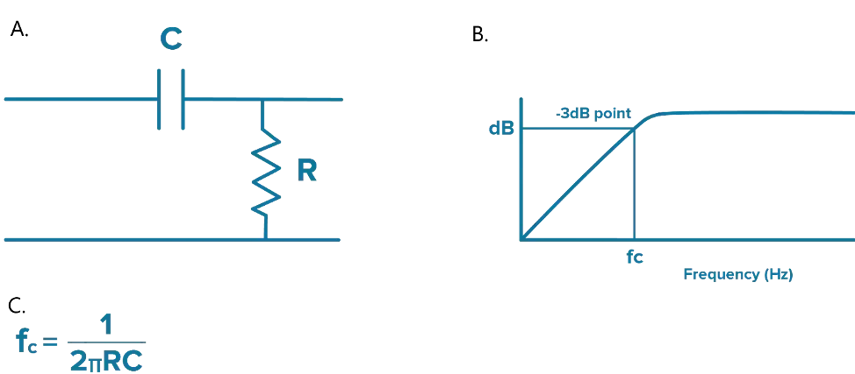
In practice, the above formula assumes ideal conditions. Real-world manufacturing processes introduce parasitic inductance that moves the equation to an approximation. But using this we can get a sense of the capacitance value required to pass frequencies we are interested in and to block frequencies we do not want. Any capacitance can block DC, but a designer should consider the minimum frequency they want to pass when selecting a capacitor value.
How Knowles Precision Devices Delivers Desired Capacitor Performance